
Planet field guide · For families
Venus: the cloudy planet with a backwards spin
Venus is Earth's neighbouring planet, wrapped in thick clouds that hide its surface from ordinary cameras. It is also the hottest planet in our Solar System. This guide explores the real science behind Venus, with questions and a simple model to try together.
Venus at a glance
- Place from the Sun
- Second of the eight planets
- Year
- About 225 Earth days to orbit the Sun
- Rotation
- About 243 Earth days, slowly backwards
- Moons
- Zero
- Atmosphere
- Very thick and mostly carbon dioxide
- Average surface temperature
- About 464°C
A Venus year is shorter than one full Venus rotation. Venus turns very slowly in the opposite direction to most planets, so the Sun would appear to rise in the west and set in the east. A Venus solar day—from one sunrise to the next—lasts about 117 Earth days.
Why is Venus hotter than Mercury?
Mercury is closer to the Sun, but Venus has a much thicker atmosphere. Most of Venus's atmosphere is carbon dioxide. This dense blanket slows the escape of heat and makes the surface hotter than Mercury's. Venus's average surface temperature is about 464°C—hot enough to melt lead.
The pressure at Venus's surface is about 93 times the air pressure at Earth's sea level. Thick clouds made of sulfuric acid sit high above the surface. The cloud tops and the ground are very different places: the cloud deck is not a solid surface, and Venus is not a safe place for people to visit.
A surface hidden by clouds
Venus's thick clouds block our view of the ground, so scientists use radar to map the surface. Radar sends out radio waves and measures the echoes that bounce back. NASA's Magellan spacecraft used radar to map nearly the whole planet in the 1990s.
Those maps revealed a rocky world with broad plains, mountains, impact craters and many volcanic features. Venus has volcanoes and lava-shaped landscapes, but scientists continue to investigate how active the planet is today. The radar maps help researchers study features they cannot see through the clouds with ordinary cameras.
A signal is a question, not an answer
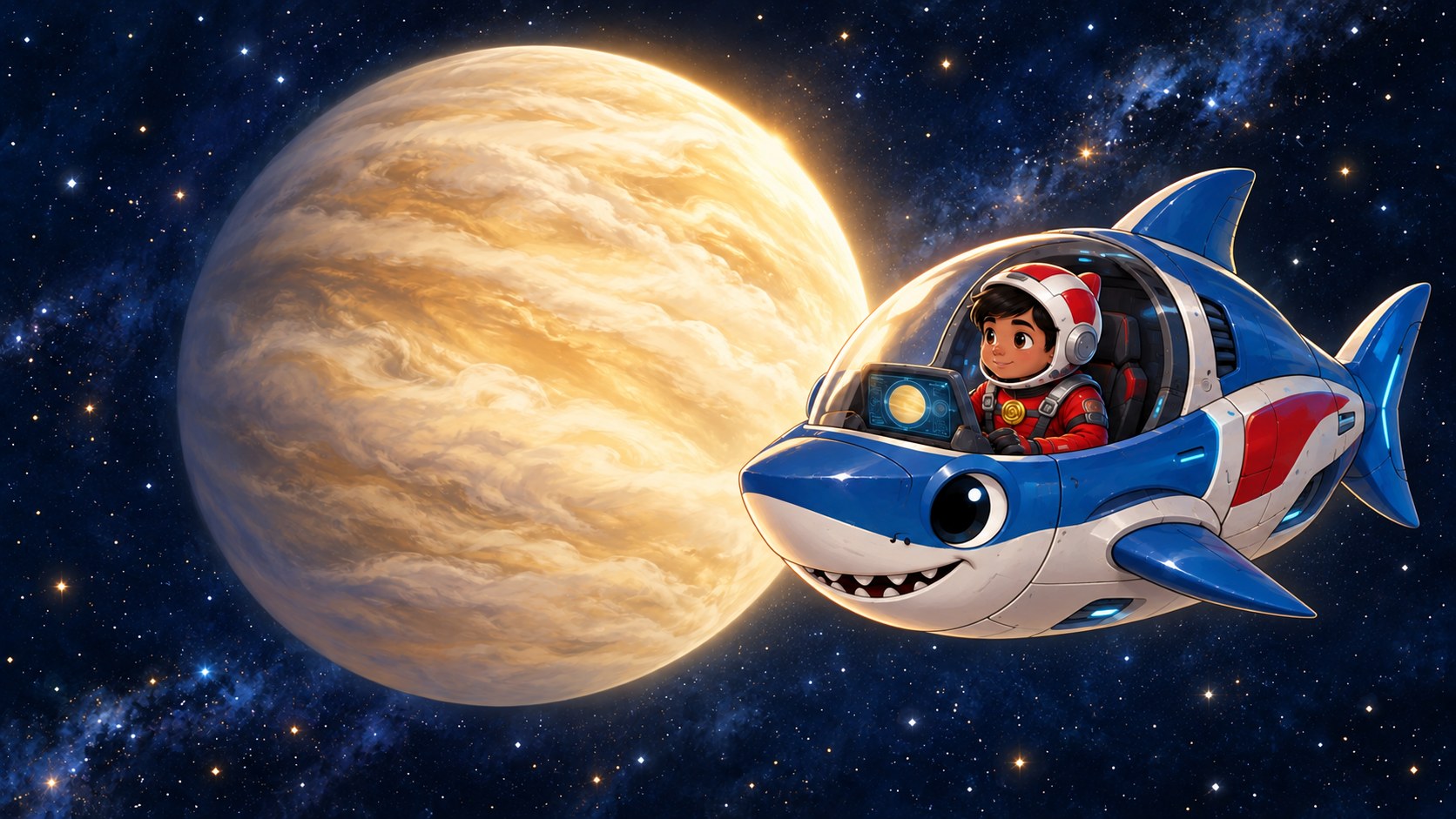
In Mission Venus, Gavin and Denny investigate a repeating signal near the planet. Their story is make-believe. A repeating pattern can have many possible explanations, so the crew compares ideas and tests them instead of deciding too early that it came from life.
That is a useful science habit in real life too: notice what the evidence shows, consider more than one explanation, and collect more observations before reaching a conclusion. Scientists have not confirmed life on Venus.
Try this together
Model Venus's backwards spin
- Place one object in the middle to represent the Sun. Use a second object as Venus.
- Move Venus once around the Sun in a circle. Each trip around represents one Venus year.
- As it travels, slowly turn Venus in the direction opposite to the direction it moves around the Sun.
- Count the model's orbits and spins. Talk about how a planet can take longer to spin once than to orbit the Sun once.
For grown-ups: This tabletop model shows the direction and relative idea only; it is not to scale and does not reproduce Venus's exact timing or tilt. Never look directly at the Sun.
How we check the science
Gavin, Denny and their missions are fictional. Planet facts are checked against primary science sources before they are used in a guide. We keep the language simple for children, and link to the original science material so parents and educators can explore further.
- NASA Science: Venus facts — orbit, rotation, atmosphere, temperature and surface overview.
- NASA Science: Magellan mission — radar mapping and spacecraft discoveries.
- NASA Science: Temperatures across our Solar System — why Venus is the hottest planet.
Science pages can change as missions return new evidence. We will update this guide if its sources or the scientific understanding change.